Unit Five American and British Political Systems
The separation of powers is the symbol of the political systems in both countries, yet the forms in each country differ, the essence of which is the dictatorship of the bourgeoisie. This unit is going to briefly introduce the political systems of both counties.
Passage 1 American Civics
[A]Civics is a subject that deals with the rights and duties of citizens. It brings together law, history and political science. In the nineteen sixties, a nonprofit group called the Center for Civic Education got started. Its job is to help people in the United States and other countries learn about the ideas of democracy. Its work includes an international civic education exchange program, Civitas. In nineteen ninety-four, the Center for Civic Education developed five questions for teaching about civics and government.
[B]Question one: "What are civic life, politics and government?" The simple answer is that people have their personal life, but they also have a civic life. This involves issues that affect their community and their nation. Politics is a process. It is a way for people with opposing interests and beliefs about issues to reach decisions. Government is the organization in society with the power to put these decisions into effect. It also has the power to enforce them. In the United States, the Constitution limits the power of government. The founders of the nation wanted to protect individual rights. At the same time, however, they also wanted to work for the common good. Under the Constitution, government officials must follow the rule of law. This means they must follow the same rules as everyone else. The Constitution is the highest law in the land.
|
|
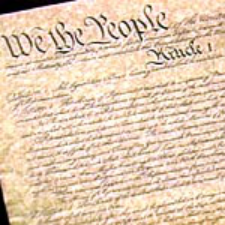
U.S. Constitution 美国宪法 |
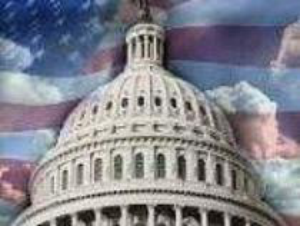
US Capitol 美国国会山 |
|
|
[C]Constitutions are also vehicles for change. One example involves the Fourteenth Amendment to the United States Constitution. The Fourteenth Amendment took effect in eighteen sixty-eight, after the Civil War. It guarantees all citizens equal protection under the law. It meant that former slaves had the same rights as other Americans. Black Americans used this amendment to seek better treatment during the civil rights movement of the nineteen fifties and sixties.
[D]The second question presented by the Center for Civic Education asks: "What are the foundations of the American political system?" The system is built on the Constitution, which guarantees the right to life, liberty and property. The Constitution also establishes a system of checks and balances on government power. Congress passes bills for the president to sign into law. If the president refuses, Congress has the power to reject the veto. The Supreme Court has the power to strike down laws if it finds they violate the Constitution. The Constitution also recognizes the powers of the states. In fact, the American political system is built on the idea that states have any powers not given to the federal government. The system was also built on the idea that the different groups in society would all share a common identity as Americans.
[E]And several intellectual traditions have influenced the American political system. One is classic liberalism. Classic liberalism represents the idea that governments are created by the people, for the people. This theory had its roots in Europe, through writers like John Locke. The American Declaration of Independence is an example of a document that supports the main ideas of classic liberalism. It guaranteed the right to "life, liberty and the pursuit of happiness."Another theory that influenced early America is classic republicanism. A republic is a state governed by elected representatives instead of directly by the people. The United States is known as a constitutional representative democracy. Classic republicanism links the idea of civic virtue to the common good. Civic virtue means that people put the interests of society before their own. But a belief in the public good may conflict with a desire for the protection of individual rights. So classic republicanism and classic liberalism can sometimes clash.
[F]Here is question number three from the Center for Civic Education: "How does the government established by the Constitution embody the purposes, values and principles of American democracy?" There are many ideas behind American democracy, but one of the most important is federalism.
Early leaders wanted to create a government system that would prevent the misuse of power. So they created several levels of government. Power and responsibilities are divided among the national, state and local governments.
[G]The federal government is organized into the legislative, executive and judicial branches. The legislative branch is Congress, made up of the House of Representatives and the Senate. The judicial branch is the Supreme Court and the federal court system. The executive branch is the president and the fifteen cabinet-level agencies. The federal government also has about sixty independent agencies.
[H]State governments are established by state constitutions. Each of the fifty states has its own legislative, executive and judicial branch. State and local governments provide police and fire protection, education, public works and other services. To pay for services, taxes are collected at all levels of government. The American political system also provides citizens with the ability to influence how laws are made. Some people become involved in political or public interest groups. Others are civically active through groups such as unions or religious organizations. The Constitution guarantees freedom of speech and of the press. So the media also play a part in civic life and shaping public opinion.
[I]"What is the relationship of the United States to other nations and to world affairs?" This is the fourth question asked by the Center for Civic Education. At times, the United States has closed itself off from the world. At other times, it has been an active leader. National politics and the guiding ideas of the Constitution have shaped and reshaped relations. Disagreements over foreign policy have led to difficult periods in American history. The United States declared its independence from Britain on July fourth, seventeen seventy-six. Today, it is often called the last remaining superpower, after the fall of the Soviet Union. But military strength is only one measure of power. Economic power also influences relations between countries. And the United States has the largest economy in the world.
[J]The final question asks: "What are the roles of citizens in American democracy? "In the words of the Center for Civic Education, "democratic citizens are active." They must know what their personal, political and economic rights are. And they must know what responsibilities come with those rights. The center says those responsibilities include voting in elections and giving time to community organizations. It says another responsibility is serving as a helpful critic of public organizations, officials and policies. But, above all, it says people must see how democracy depends on knowledgeable citizens who care about other citizens and their country. This is what Abraham Lincoln, the sixteenth president, said in eighteen fifty-four: "If there is anything which it is the duty of the whole people to never entrust to any hands but their own, that thing is the preservation and perpetuity of their own liberties and institutions." In other words, to keep democracy alive, citizens must do it themselves.
[K]The Center for Civic Education organized its teachings around questions because, in its words, "democracy is a discussion." Citizens exchange ideas. They search for new and better ways. The use of questions is meant to show that the process is never-ending.
Notes to the Text
Civics:公民学a subject dealing with the rights and duties of citizens and the way government works.
nonprofit: not aiming at making money
the Center for Civic Education:美国公民教育中心civic:城市的,市民的connected with a town or city. E.g .It is her civic duty to vote in the elections.
the ideas of democracy: 民主制度的思想。democracy:民主制度 a system of government in which everyone in the country can vote to elect its members.
an international civic education exchange program: 一个国际公民教育exchange: (意见等)交换a mutual expression of views. E.g. They had a serious exchange of views in the morning.
opposing: be against each other.
put sth into effect: to make a plan or idea happen.
It also has the power to enforce them: The government also has the power to make people or organizations obey its decisions by force. enforce:强制执行 to make people obey a rule or law.
the Constitution: 宪法the system of basic laws and principles that a democratic country is governed by.
founder: someone who establishes an organization, business or school, etc.
the common good: the benefit of the public.
vehicle: a transportation tool that is used for carrying people or things from one place to another.
the Fourteenth Amendment to the United States Constitution: 美国宪法第十四条修正案amendment: 修正案a written change or improvement to a law or document.
take effect: to start to produce effect.
seek: look for
a system of checks and balances on government power: a system that can both restraint and balance the government power. check: 控制,节制It is used as a noun in the passage which means “something that controls something else and stops it from getting worse”.
Congress: 美国国会
bill: 议案a written proposal for a new law, which is brought to the congress so that it can be discussed.
reject the veto: refuse a refusal. A veto is a refusal to give official permission for something.E.g. Kitty rejected her brother’s offer of help. veto: 否决权the power or right to prohibit or reject a proposed or intended act. E.g. The president exercised a veto on the environmental protection bill.
strike down laws: to refuse to pass the law.
violate: 侵犯,违反to disobey or do something against an official agreement.
identity: 身份who somebody is.
classic liberalism: 经典自由主义
John Locke (1632-1704): English philosopher. Locke's notions of a "government with the consent of the governed" and man's natural rights - life, liberty, and estate (property)- had an enormous influence on the development of political philosophy.
The American Declaration of Independence: 美国独立宣言
liberty: freedom
classic republicanism:经典共和主义
representative democracy:代议民主制。
virtue: 道德the quality of doing what is right and avoiding what is wrong.
clash: conflict with each other.
embody:体现 express or show
federalism:联邦主义
the misuse of power: 滥用职权the use of power in the wrong way or for the wrong purpose. misuse: 误用,滥用the use of something in the wrong way or for the wrong purpose. E.g. The bank has designed a system to prevent the misuse of credit cards.
legislative:立法的a legislative institution has the power to make laws.
executive:执法的connected with making decisions and organizations.
judicial:司法的 connected with a court of law, judges or their decisions.
the legislative, executive and judicial branches: 立法﹑执法与司法机构
the House of Representatives: 美国众议院
the Senate:美国参议院
the Supreme Court: 最高法院 The final court of appeal and the authority of the American Constitution.
cabinet-level agencies:内阁机构
freedom of speech and of the press: the freedom of speaking to the public and publicize opinions in any forms of media.
declare: to state officially or publicly
the fall of the Soviet Union:苏联解体 the collapse of the other former superpower-- the Soviet Union in the year 1991.
military: 军事的 connected with war or the army.
strength: power
critic:评论家,批评家someone whose job is to make judgments about the good and bad qualities of something.
above all: the most important.
"If there is anything which it is the duty of the whole people to never entrust to any hands but their own, that thing is the preservation and perpetuity of their own liberties and institutions.": 如果有一件事情是全体人民皆有责任掌握在自己手中而不是委托给任何其他人的,这件事就是永远维护他们自己所拥有的自由和体制.
entrust: 委任to make something responsible for doing something important.
preservation: the act of keeping something unharmed or unchanged.
perpetuity: 永久,永恒 the state of being forever or for a long time.
institution: 制度,习俗an established system or custom. E.g. institution of marriage
Vocabulary
Nouns
Civics:公民学a subject dealing with the rights and duties of citizens and the way government works.
democracy:民主制度 a system of government in which everyone in the country can vote to elect its members.
exchange: (意见等)交换a mutual expression of views.
constitution:宪法 the system of basic laws and principles that a democratic country is governed by.
founder: someone who establishes an organization, business or school, etc.
vehicle: a transportation tool that is used for carrying people or things from one place to another.
amendment: 修正案a written change or improvement to a law or document.
check: 控制,节制It is used as a noun in the passage which means “something that controls something else and stops it from getting worse”.
bill: 议案a written proposal for a new law, which is brought to the congress so that it can be discussed.
veto: 否决权the power or right to prohibit or reject a proposed or intended act.
identity: 身份who somebody is.
liberty: freedom
virtue: 道德the quality of doing what is right and avoiding what is wrong.
misuse: 误用,滥用the use of something in the wrong way or for the wrong purpose.
strength: power
critic:评论家,批评家someone whose job is to make judgments about the good and bad qualities of something.
preservation: the act of keeping something unharmed or unchanged.
perpetuity: 永久,永恒 the state of being forever or for a long time.
institution: 制度,习俗an established system or custom. E.g. institution of marriage
Verbs
enforce:强制执行 to make people obey a rule or law.
seek: look for
clash: conflict with each other.
reject: refuse, deny.
violate: 侵犯,违反to disobey or do something against an official agreement.
embody:体现 express or show
declare: to state officially or publicly
entrust: 委任to make something responsible for doing something important.
Adjectives
nonprofit: not aiming at making money
civic:城市的,市民的connected with a town or city.
opposing: be against each other.
legislative:立法的a legislative institution has the power to make laws.
executive:执法的connected with making decisions and organizations.
judicial:司法的 connected with a court of law, judges or their decisions.
military: 军事的 connected with war or the army.
Phrases
put sth into effect: to make a plan or idea happen.
take effect: to start to produce effect.
above all: the most important.
Culture Note
The American Declaration of Independence: 美国独立宣言It is stated clearly in the Declaration that “We hold these Truths to be self-evident, that all men are created equal, that they are endowed with certain unalienable Rights, that among these are Life, Liberty, and the Pursuit of Happiness.”
representative democracy:代议民主制。一种政府形式,由人民选出的民意代表行使决策权力,其权力则受到法治的监督和限制,通常还会采纳保障个人及少数派权利和自由的宪法,同时也限制了多数派及其选出的领导人的权力。
federalism:联邦主义belief in or support for a federal system of government. A federal system of government consists of a group of states which have their own government to decide their own addairs and are controlled by a single national government which makes decisions on foreign affairs, defense and so on.
the House of Representatives: 美国众议院one of the two houses of the legislature of the United States, established in 1789 under the Constitution.
the Senate:美国参议院one of the two houses of the legislature of the United States, established in 1789 under the Constitution.
cabinet-level agencies:内阁机构 They are 15 U.S. Government agencies that make up the President's Cabinet:
请同学们继续学习
